


ST1901 TOP Grade vs. Standard Grade: Is the Upgrade Worth It?
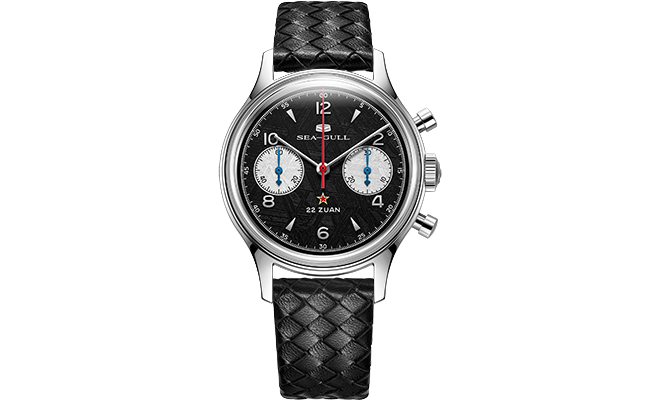
If you’re a watch enthusiast eyeing Seagull’s iconic ST1901 chronograph movement—made famous by the 1963 Chinese Air Force time piece—you’ve likely encountered two versions: Standard Grade and TOP Grade. The question looms: Is the premium for TOP Grade justified?
Short answer: Absolutely—if you crave a museum-worthy movement that rivals Swiss finishing at a fraction of the cost, with visible craftsmanship that shines through a display caseback. And here’s the kicker: TOP Grade is strictly exclusive to Seagull’s official watches; third-party brands can’t get their hands on it, no matter the budget.
Below, we break down the three defining differences in finishing—Rhodium Plating, Hand-polished Bridges, and Geneva Stripes—with industry standards and technical details, plus why Seagull guards TOP Grade as its crown jewel.
1. Rhodium Plating: More Than Just a Shine—Durability Meets Luxury
The first thing you’ll notice when comparing the two grades is their color—and that difference stems from plating technology that separates everyday movements from heirloom pieces. According to surface treatment industry standards, rhodium plating’s superiority lies in its chemical stability and wear resistance, outperforming nickel by a significant margin .
Standard Grade: Nickel-Plated Practicality
Standard Grade ST1901 uses nickel plating or a thin gold-tone coating on brass components. Visually, it has a warm, yellowish sheen that can look industrial up close.
- Technical Specs:Coating thickness of 1–2 microns; surface roughness (Ra) ≥ 0.2 μm
- Durability:Nickel is prone to tarnishing and discoloration over 2–3 years, especially in humid environments (e.g., coastal areas or sweaty wrists)
- Aesthetics:Matte reflectivity with no depth; fails to meet luxury watch finishing standards
For closed-caseback watches, this might suffice—but it’s a letdown for anyone who wants to admire their movement through a display caseback.

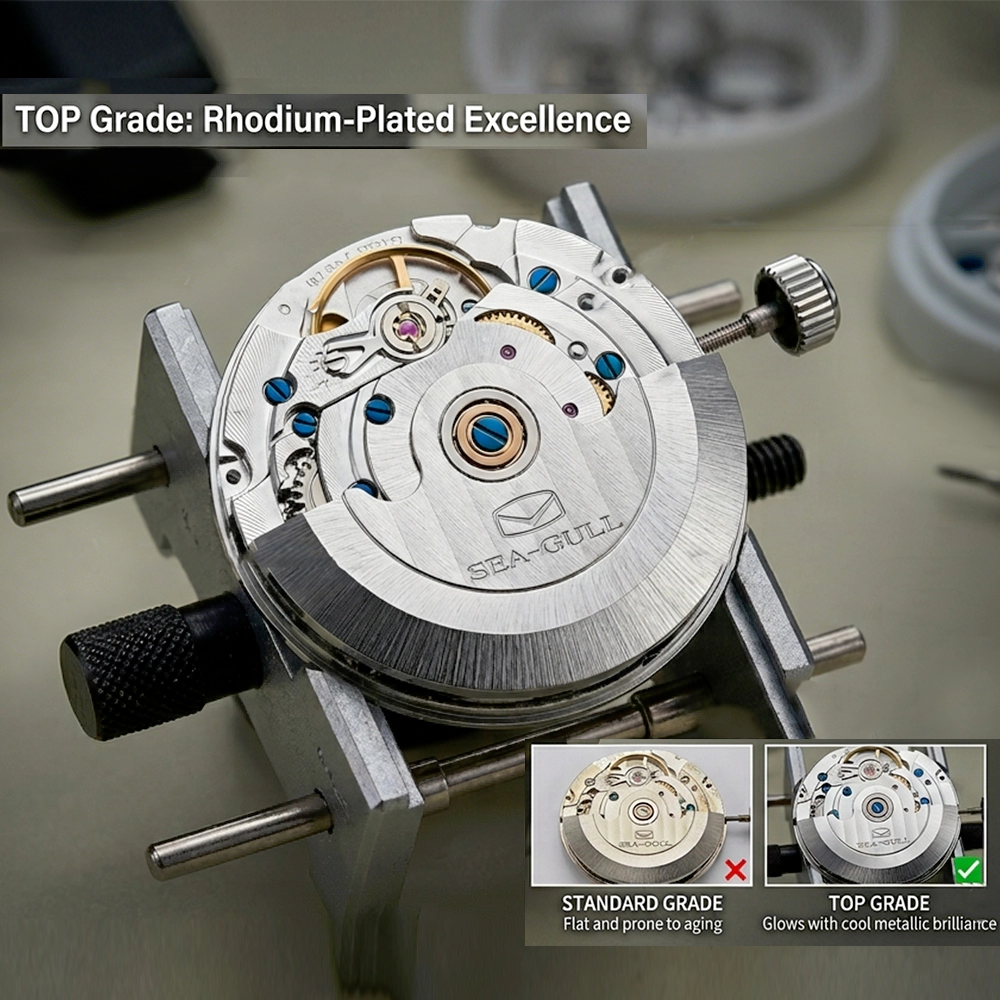
TOP Grade: Rhodium-Plated Excellence
TOP Grade elevates the game with full rhodium plating (3–5 microns thick)—a precious metal from the platinum family with a reflectivity of 80% that remains unchanged for decades .
- Technical Specs:Uses aminosulfonic acid rhodium plating for crack-free coverage; surface roughness (Ra) ≤ 0.05 μm (mirror polish standard)
- Durability:Scratch-resistant, corrosion-proof, and tarnish-free—withstands daily wear for 10+ years
- Aesthetics: Crisp white-silver luster that mimics high-end Swiss chronographs (e.g., Valjoux 72); heat-treated blued screws create striking contrast
Every component—from bridges to screws—gets the rhodium treatment, protecting the movement from moisture and oxidation while exuding luxury.
Visual Test: Tilt the movement under light—TOP Grade glows with cool metallic brilliance, while Standard Grade looks flat and prone to aging.

Rhodium Plating Comparison
| Standard Grade (Left) | TOP Grade (Right) |
|---|---|
| 1–2μm nickel coating | 3–5μm rhodium plating (aminosulfonic acid process) |
| Warm yellowish, matte finish (Ra ≥ 0.2μm) | Cool white-silver, mirror finish (Ra ≤ 0.05μm) |
| Tarnishes in 2–3 years | Tarnish-proof for decades |
| Plain steel screws | Heat-treated blued screws (high contrast) |

2. Hand-polished Bridges: Craftsmanship You Can Feel
In watchmaking, bridges aren’t just structural—they’re canvases for craftsmanship. The way they’re finished separates mass-produced movements from handcrafted works of art, with hand polishing being the gold standard for luxury timepieces .
Standard Grade: Machine-Cut Efficiency
Standard Grade bridges are machine-stamped and mass-finished, prioritizing speed over precision.
- Process: Automated grinding with no manual touch-ups; edges remain sharp and unbevelled
- Quality: Visible tool marks; sparse, shallow perlage (fish-scale engravings) with inconsistent spacing
- Compliance: Meets basic industry standards but fails to meet GB/T 38023-2019 luxury finishing requirements
Chronograph levers get minimal attention—simple machine polishing with no beveling, resulting in a utilitarian look that prioritizes function over form.
TOP Grade: Master Watchmakers’ Touch
TOP Grade bridges are hand-finished by Seagull’s master craftsmen (5+ years of experience required), following Swiss-style finishing protocols .
- Process:3-stage hand polishing: rough grinding → fine sanding → mirror buffing; edges hand-chamfered at 45°
- Quality:Deep, uniform perlage (1.2mm diameter circles) across all plates; no tool marks or imperfections
- Compliance:Exceeds GB/T 38023-2019 standards—all edges (beveled and polished);surface flatness ≤ 0.01mm
Even small components like chronograph levers get high-gloss flat polishing, with blued screws that pop against the rhodium plating—a detail reserved for luxury movements.
Why It Matters:Hand-polished bridges enhance light play. As light hits the bevelled edges, the movement comes alive with facets that shimmer like gemstones. Standard Grade, by contrast, looks static and one-dimensional.
Hand-Polished Bridges Comparison
| Standard Grade (Left) | TOP Grade (Right) |
|---|---|
| Machine-cut edges (sharp, unbevelled) | Hand-chamfered edges (45° polished line) |
| Sparse, shallow perlage (inconsistent) | Deep, uniform perlage (1.2mm perfect circles) |
| Surface roughness Ra ≥ 0.2μm | Mirror polish (Ra ≤ 0.05μm) |
| Plain steel screws | Heat-treated blued screws |
| Tool marks visible under 10x magnification | No imperfections (100% manual inspection) |

3. Geneva Stripes: The Mark of High-End Watchmaking
Geneva Stripes (Côtes de Genève) are more than decoration—they’re a historical badge of quality. Originally designed to trap dust in non-waterproof vintage watches, today they serve as a testament to meticulous craftsmanship.
Standard Grade: Machine-Stamped Mediocrity
Standard Grade uses shallow, machine-stamped stripes with industrial-level precision.
- Process:Automated stamping with no post-finishing; lines created by fixed grinding tools
- Quality:Uneven depth (0.01–0.02mm); wavy lines with inconsistent spacing; partial coverage (only main bridge)
- Aesthetics:Dull finish with no reflectivity; looks printed rather than crafted
These stripes barely serve the historical dust-trapping function, let alone aesthetic ones.
TOP Grade: Hand-Applied Perfection
TOP Grade features hand-applied Geneva Stripes—the traditional method used by Patek Philippe and Breguet.
- Process:Craftsmen use hand-guided rotating grinding tools (wooden tips with abrasive coating) to create lines; each component is adjusted individually
- Quality:Deep, uniform depth (0.03–0.04mm); perfectly parallel lines; full coverage (all visible bridges/modules)
- Precision:Stripes align seamlessly across component joints—no breaks or smudges (a feat impossible with machines)
After stamping, stripes are polished to a bright, reflective finish that mimics the ripples of Lake Geneva.
Visual Difference:Tilt a TOP Grade movement, and the stripes “flow” with light, creating a sunburst effect. Standard Grade stripes look flat and lifeless.
Geneva Stripes Comparison
| Standard Grade (Left) | TOP Grade (Right) |
|---|---|
| Machine-stamped (fixed tool) | Hand-applied (craftsman-guided) |
| Shallow depth (0.01–0.02mm) | Deep depth (0.03–0.04mm) |
| Partial coverage (only main bridge) | Full coverage (all visible components) |
| Wavy, inconsistent lines | Perfectly parallel lines |
| Dull finish (no post-polishing) | Bright, reflective sunburst effect |

Full Comparison Table: At a Glance
| Feature | Standard Grade | TOP Grade | Upgrade Impact |
|---|---|---|---|
| Rhodium Plating | 1–2μm nickel (Ra ≥ 0.2μm) | 3–5μm rhodium (Ra ≤ 0.05μm) | Tarnish-proof; luxury mirror finish |
| Hand-polished Bridges | Machine-cut; sparse perlage | Hand-chamfered; deep uniform perlage | Light-catching facets; museum-level quality |
| Geneva Stripes | Shallow machine-stamped; partial coverage | Deep hand-applied; full coverage | Swiss luxury craftsmanship; historical authenticity |
| Screws | Plain steel | Heat-treated blued screws | Visual contrast; premium detail |
| Accuracy | ±20–30 seconds/day | ±10–15 seconds/day (3-position hand-regulated) | Superior timekeeping |
| Quality Control | 10% spot-check | 100% manual inspection (20x magnification) | Zero defects; collectible value |
| Availability | Sold to third parties | Seagull official watches only | Exclusive ownership |

4. Why TOP Grade Is Exclusively for Seagull Official Watches>
You might wonder: Why can’t third-party microbrands get TOP Grade ST1901? The answer lies in Seagull’s strategic vision, production constraints, and commitment to quality—backed by industry realities.
4.1 Brand Protection & Premium Positioning
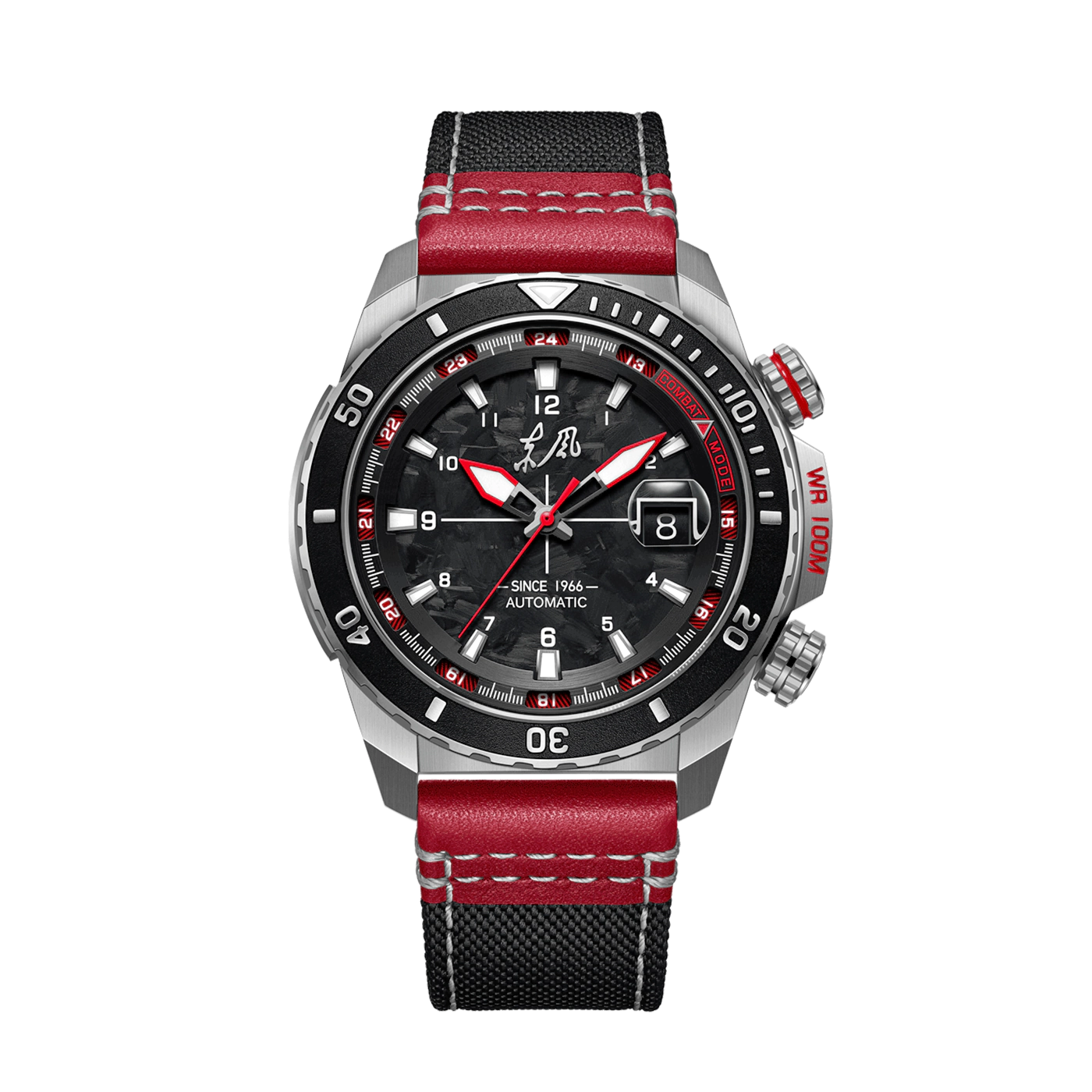
The ST1901 is Seagull’s legacy movement, rooted in its 1963 Air Force chronograph heritage. TOP Grade defines Seagull’s luxury identity, reserved for its own collector lines (1963 Full Skeleton, Wind Chaser).
If sold to third parties, Seagull’s official watches would lose their unique selling point: Swiss-level finishing at 1/10 the price of Swiss chronographs.
4.2 Production Capacity & Cost
- Labor Intensity:A single TOP Grade movement takes 8+ hours of master craftsmen’s time (vs. 1 hour for Standard Grade)
- Scarcity: Only 5–10% of ST1901 production meets TOP Grade standards (due to strict finishing requirements)
- Material Costs:Rhodium is 5x more expensive than nickel; hand-polishing consumes 3x more abrasive materials
Seagull can’t afford to supply external brands at competitive prices while maintaining quality.
4.3 Quality Control & Exclusivity
TOP Grade undergoes 100% manual inspection (20x magnification) per GB/T 38023-2019 standards . Third-party brands, focused on cost-cutting, would skip these checks—diluting the ST1901’s reputation.
Seagull guards this process to ensure only its most premium watches carry the TOP Grade badge.
4.4 Historical Heritage
The ST1901’s roots in the Chinese Air Force demand respect. TOP Grade honors that legacy by using traditional craftsmanship (hand polishing, rhodium plating, Geneva Stripes) that pays tribute to the original 1963 model .
Seagull wants this heritage to be exclusive to its own watches—not third-party homages that cut corners.

5. Common Questions (User Pain Points Answered)
Q1: How to spot fake TOP Grade ST1901?
Third-party brands often claim to sell “TOP Grade”—here’s how to verify authenticity:
✅Color:Cool white-silver rhodium (not yellow/gold nickel)
✅Edges:Hand-bevelled bridges with sharp, reflective lines (no tool marks)
✅Stripes:Deep, uniform Geneva Stripes on all components (not just main bridge)
✅Screws:Heat-treated blued screws (not plain steel)
✅Source:Only available in Seagull’s official watches (check SKU: e.g., M190SK for 1963 Full Skeleton)

Q2: Is TOP Grade worth it for a closed-caseback watch?
No—if you can’t see the movement, the finishing upgrades will go unnoticed. Stick with Standard Grade to save money.
Q3: Can third parties modify Standard Grade to look like TOP Grade?
Some try—they may rhodium-plate Standard Grade or add shallow stripes. But telltale signs:
- Uneven beveling (machine-cut vs. hand-chamfered)
- Sparse perlage (no way to replicate hand-applied depth)
- Incomplete Geneva Stripes (missing from small components)
These modifications never match Seagull’s factory TOP Grade.
6. Is the Upgrade Worth It?
✅ Yes If:
- You own a display caseback watch (finishing is fully visible)
- You value long-term durability (rhodium + hand polishing last decades)
- You’re a collector seeking Seagull’s true flagship movement
- You want Swiss-level aesthetics without the $5k+ Swiss price tag
❌ No If:
- Your watch has a closed caseback (you’ll never see the finishing)
- You prioritize function over form (Standard Grade is reliable but utilitarian)
- You’re buying a third-party watch (you can’t get genuine TOP Grade)

Final Verdict
The ST1901 TOP Grade isn’t just an upgrade—it’s a statement. It proves Seagull can deliver luxury watchmaking craftsmanship at an accessible price, honoring its military heritage while competing with Swiss brands.
For display caseback watches and collectors, the upgrade is 100% worth it—you’re getting a movement that’s as beautiful as it is functional.
And remember: If a third-party brand claims to use “TOP Grade ST1901,” it’s likely a modified Standard Grade. True TOP Grade is only available in Seagull’s official watches—another reason to invest in the real deal.
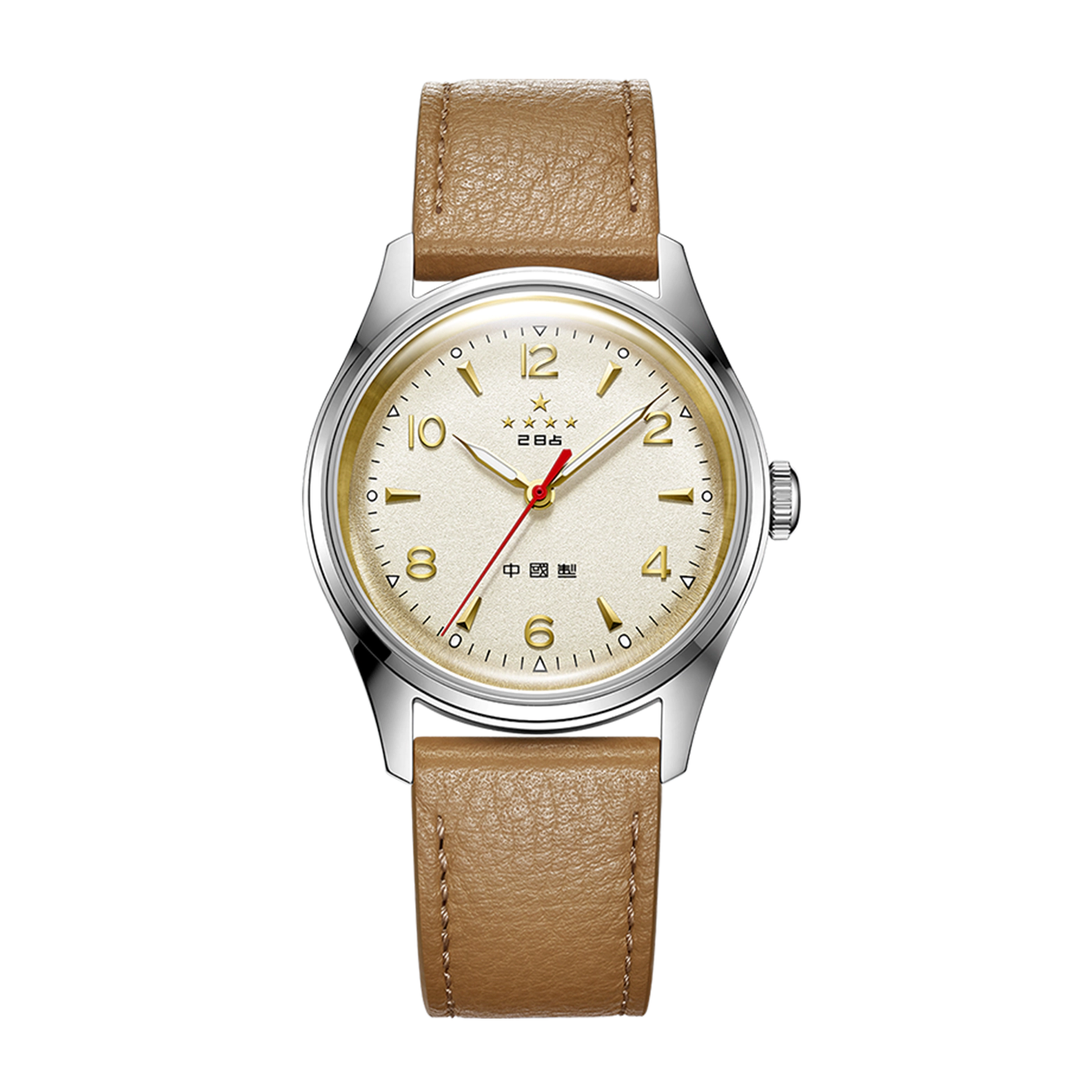
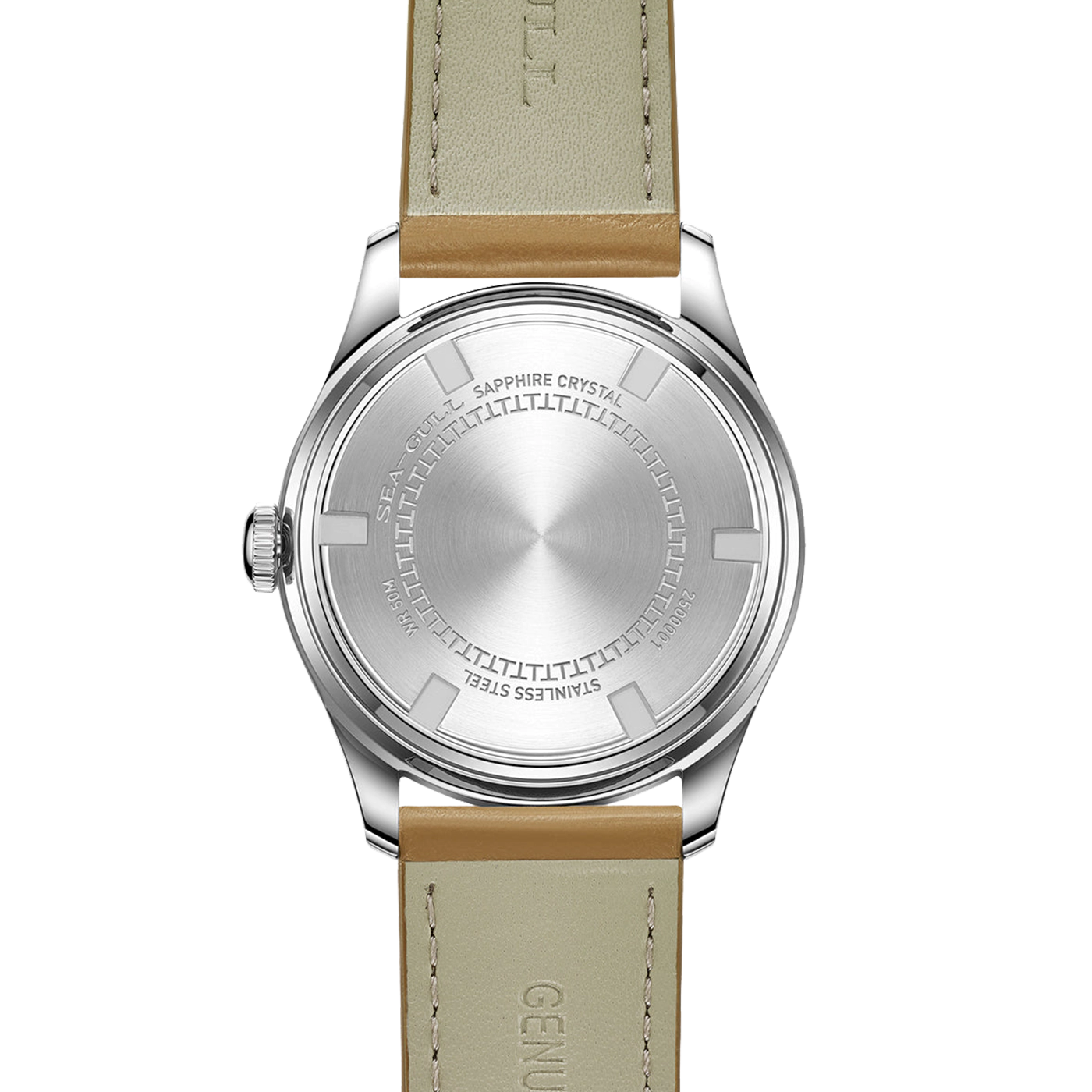
Ready to experience the artistry of ST1901 TOP Grade? The All-New Genuine SEA-GULL 1963 watch. Explore Seagull’s 1963 collector series and see the difference for yourself.





Leave a comment
This site is protected by hCaptcha and the hCaptcha Privacy Policy and Terms of Service apply.